Customer support tooling
Support ticket routing
I wanted a small project that went beyond a notebook. This one takes a customer message through an API, saves the prediction, and leaves a place for a reviewer to correct it when the model is unsure.
The basic loop
What happens after a message comes in
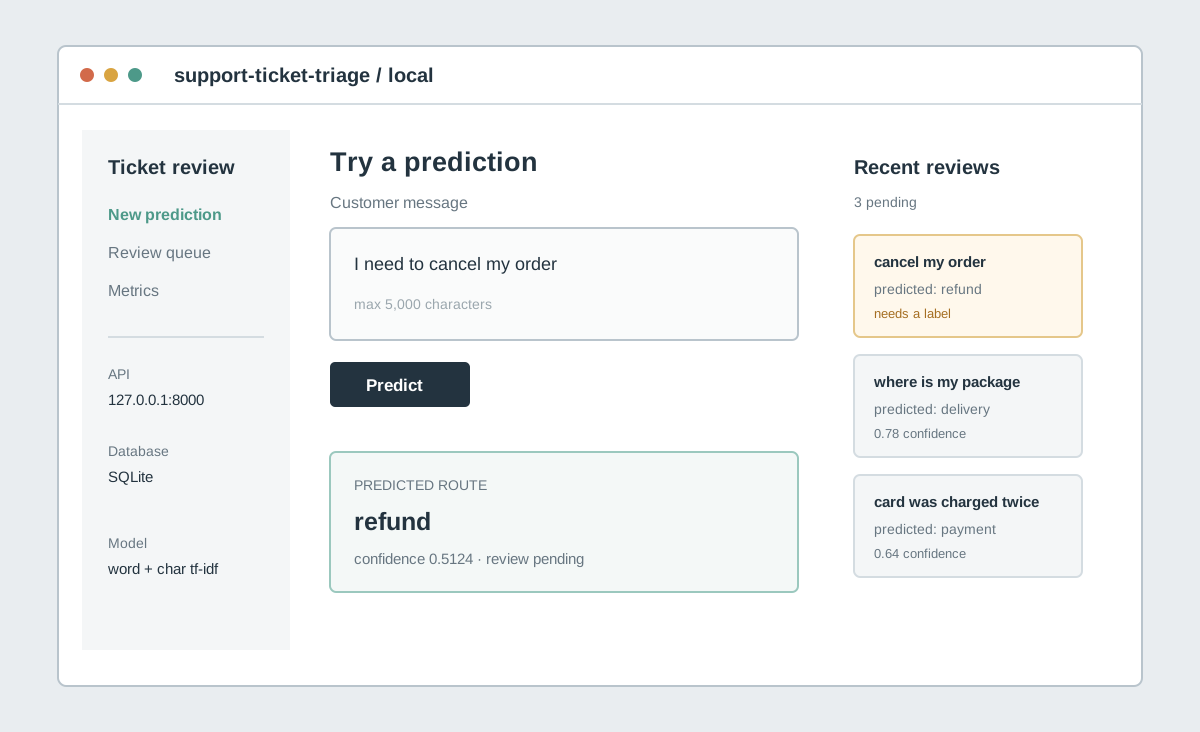
The dashboard sends the message to FastAPI. The API chooses a route, calculates a confidence score, writes the result to SQLite, and returns the top alternatives. When the score is below 0.60, the row stays in the review queue instead of being treated as settled.
Model choice
I kept the first model deliberately boring
The serving model is a word-and-character TF-IDF pipeline with logistic regression. Word features handle common phrases; character features help with spelling differences and short messages. A few explicit rules cover requests that are easy to recognize, such as cancelling an order.
The shared router has ten coarse routes, including account, card, order delivery, payment, refund, transfer, and an `other` bucket. The two source datasets use different original labels, so I mapped them into this smaller set rather than pretending the taxonomies were identical.
Review queue
The uncertain cases are still part of the system
A prediction is not the same thing as a confirmed label. The API returns the route, confidence, alternatives, and review status. A reviewer can submit a corrected route through the dashboard or POST /review/:prediction_id.
POST /predict
{
  "text": "I need to cancel my order"
}

→ { "route": "refund", "confidence": 0.5124,
    "needs_review": true, "review_status": "pending" }
There is also a 40-row challenge set that is kept separate from training and rule changes. It is small, but it gives me a fixed place to check whether a new experiment actually helps.
Experiments
The bigger experiment did not help this dataset
I tried frozen BERT embeddings and a confidence-calibration step. Both stayed in the repository as comparisons; neither replaced the smaller serving model.
| Experiment | Challenge Macro-F1 | Decision |
|---|---|---|
| Word + character TF-IDF | 0.7922 | kept |
| Frozen BERT embeddings | 0.7277 | not kept |
| Confidence calibration | 0.7642 | not kept |
The main reason is simple: the alternatives were worse on the frozen challenge set. Keeping that result visible is more useful than presenting only the model that made it into the API.
Before real use
What I would change before connecting real tickets
- Replace the public and synthetic data with a reviewed sample from the actual support queue.
- Move from local SQLite to a managed database if more than one API instance is needed.
- Measure correction rates by route instead of relying on one overall score.
- Add authentication and audit permissions before exposing the review endpoint.